

A note on AI use: My posts are written by me. I use AI to check grammar and spelling, generate images and charts, and analyse data or large amounts of text. I also use it to review my writing and get feedback, which I decide whether to use.
Have you wondered about the “Designed by Apple in California, Assembled in China (or India)” tagline on an iPhone box? What does it take to build an iPhone, a device that most of either have or know of. Yes, Samsung and other Android users, you too!
I recently read Chip War by Chris Miller. A must read for technology enthusiasts and anyone who wants to understand history of semiconductors, chip-making and the fragile supply chain. While studying Electronics Engineering, chip design and working for a chip maker was my dream career. Well, couldn’t land that but ended up being heavy chip user!
This post is inspired by Chip War. We take technology for granted. All of the technology that we use today is built using many complex layers. An iPhone is no exception.

The Finished Product

This is what you see and use. Use it to make phone calls on cellular network, take pictures, listen to music, watch HD videos, scroll and troll maybe. Record voices of loved ones. Maybe, make payments at the store by tapping your phone, use it as GPS to navigate your way through unknown places.
Isn’t it amazing, a small device can perform all these functions. These all require different hardware components and are not only software features. It is almost magical that a phone can perform all these functions.
This is where every part gets put together into the phone you’re holding right now. Screws, glue, testing, packaging into the box. The key players are Taiwanese company Foxconn (60-70%) and Pegatron (20-30%). The majority of assembly takes place in China and some in India. Apple is also expanding its assembly for other products in Vietnam.
If this stopped tomorrow, you would wait longer for a new phone. Nothing about how your phone works would change. This is the easiest stage to move somewhere else.
Holding it all together: Enclosure

Did you know that the iPhone enclosure is made up of mostly glass! Even the backside! The enclosure also uses titanium or aluminium depending upon the model. This is the metal and glass in your hand right now. The part you touch most and think about least.
Titanium is sourced from China, Japan, Russia, or Kazakhstan. Glass from Corning (US). The enclosure is manufactured mostly by Foxconn or Pegatron.
Less exposed than most of this list, but still worth knowing. Even the metal and glass you are holding has its own supply chain behind it!
The Brain – Application Processor

This is the brain. The logic processor that controls everything, all hardware, sensors and software. Every time a new version of iPhone comes out, apart from the physical features, the core processor undergoes a change. The A16 pictured here was used in iPhone 14 Pro and base iPhone 15 models.
This chip is what makes your phone feel fast. Every tap, every photo edit, every app you open runs through here.
The chip is designed in the US, fabricated in Taiwan, by the world’s biggest contract chip manufacturer TSMC (Taiwan Semiconductor Manufacturing Company).
This is the stage that should worry you most. Almost every advanced chip in your phone comes from one company on one island. If something happened there, you would not be buying a new phone (and many other things) for a long time.
The Display

Remember the first touchscreen phones? How you had to press the screen a bit hard for it to work? The new screens are way more responsive. A bit annoying at times.
Behind the glass enclosure is a complex layer of microscopic wire grid that tells the coordinates of the touch to the processor. The screen is brightly lit by LEDs (similar to OLED TVs).
These screens are mostly manufactured by Samsung (which is competition!) and LG (another competition!) in South Korea.
BOE (China) is now increasingly supplying displays alongside Samsung and LG. This is positing China well as a competitor rather than an assembly destination.
Memory Chips

The demand for memory chips has been so high that has driven the memory costs over the roof. In the last 12 months, the memory costs have increased 5-6 times.
The higher the storage capacity of the iPhone, higher the costs. This is the 256GB chip that stores all your photos, documents, videos or reels that you save!
Samsung and SK Hynix in South Korea are Apple’s primary and longest-standing suppliers for both DRAM (used for operating) and NAND (used for storage) flash memory. Chinese manufacturers are also now in the mix of suppliers.
Connectivity – Modem and RF Chips

When the first few generations of mobile phones were launched, telephony was the core purpose and functionality. I remember many earlier discussions about how mobile voice quality will always be inferior to carrier grade wired telephony!
The evolution is interesting too, first came voice, then data over voice and then the flip – voice over data. More and more mobile communication has become about data than voice.
Qualcomm a US based company does most of design for the cellular chips, and TSMC in Taiwan does the manufacturing. The Wi-Fi chips are designed by Broadcom and also manufactured by TSMC (although some are manufactured in the US). Apple has started to design its own cellular (5G) and Wi-Fi chips in-house, however they are still manufactured by TSMC.
The Powerhouse: Battery

There was time when a phone’s battery would last days. It hardly lasts a day for a moderate user these days. The chemistry inside depends on materials mined and refined thousands of kilometres apart from each other.
Cobalt is sourced from DR Congo, lithium from Chile, Argentina, Bolivia, and graphite processed in China.
China and South Korea OEM battery manufacturing companies are the major suppliers of these batteries.
There has been a lot of backlash on appalling conditions the labourers in DR Congo and other mineral extracting companies have to endure. Apple has taken steps to use recycled cobalt from old electronics for new iPhone models.
The Camera(s)

Now with a smartphone camera, everyone with a phone is a photographer. Multiple lenses, better picture quality is a huge selling point for new models.
Digital cameras depend upon light falling through the optical lens on a sensor. These sensors capture light and then convert them to pixels by an image processor.
Largan Precision in Taiwan is the largest smartphone optical lens supplier in the world. Sony in Japan, manufactures the image sensor.
Apple is moving its image sensor manufacturing to Samsung in the US (Austin facility) to manufacture the next generation of sensors. What is also interesting is the LG in South Korea assembles all the camera modules together!
In Motion: Gyroscope

The gyroscope has been a key component of the iPhone (and other smartphones) from the first-generation phones. They are needed for tilt, screen rotation and are also used in crash detection features.
Early iPhones had sensors provided by ST Microelectronics based out of Switzerland and manufactured in Italy. The new combined gyro-accelerometer chips are manufactured by Bosch Sensortec in Germany.
These chips are then sent to China/India for final assembly.
Tap to Pay – NFC Chips

While originally used for Apple Pay, these chips are now used for transit apps, secure access and even car keys. They use a very short-range radio signal to communicate.
NXP Semiconductors, a Dutch company is the main manufacturer, with global manufacturing supply chain.
Semiconductor Power: Silicon Wafers
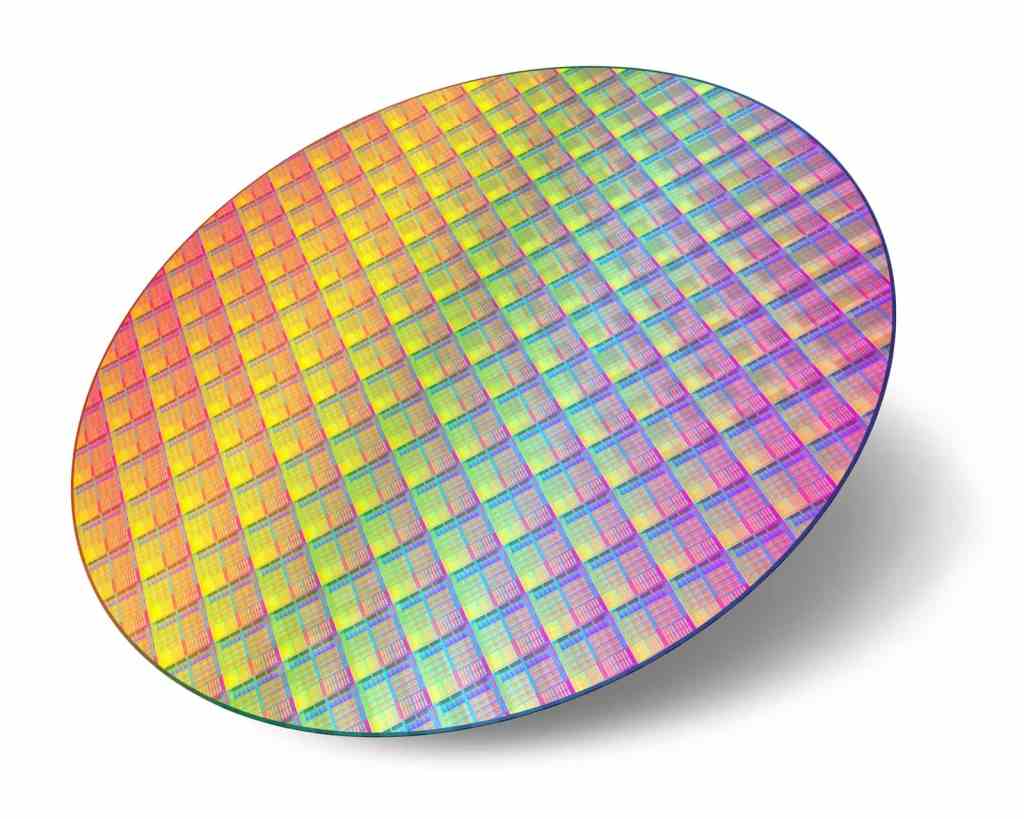
The main character. This is where the journey of every electronic component starts. Fun fact: silicon Valley has no silicon; it is called so because that is where the early semiconductor companies started making the ICs (Integrated Circuit).
Quartzite (Quartz Sandstone) from North Carolina, US, China or Brazil is converted to Metallurgical Grade Silicon (98% silicon). 70% of this process takes place in China. The conversion to electronics grade silicon takes place by a specialised chemical process in Germany, Japan or US.
The incredibly thin wafers, less than 1mm thin, (see image) are manufactured by three top suppliers: Shin-Etsu and SUMCO (Japan), GlobalWafers (Taiwan), and Siltronic (Germany).
Machine to build a Machine: Lithography
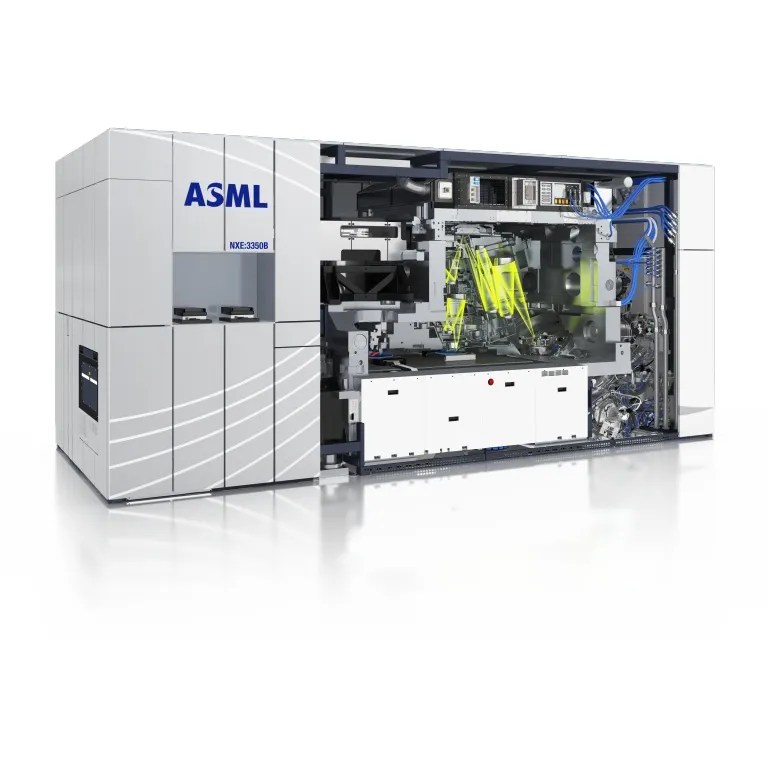
If you have followed so far, you may be wondering, how is silicon wafer converted to an electronic circuit. A key process in that is lithography. The wafer is coated in photoresist and loaded into a multi-hundred-million-dollar lithography machine made by ASML (Netherlands). The ASML machine uses Extreme Ultraviolet (EUV) light to project the master circuit designs from the photomasks onto the wafer, printing lines that are only a few nanometers wide.
ASML has no serious competition. Other companies and countries are looking at alternative technologies to imprint the circuit on the wafer.
What is interesting is that the ASML have its own complex supply-chain that is built using over 5000 partners across the globe! The double-decker bus sized machine is built in modules across the US, Netherlands and Taiwan. The machine is then reassembled at customer location (TSMC is the biggest customer of ASML).
The chicken and egg conundrum of the semiconductor industry: ASML machines rely on advanced microchips that were printed by older generations of lithography machines by ASML or Nikon.
Special Gases

Yes, iPhone manufacturing involves gases! A key part of lithography is etching using the fluorinated gases, such as Nitrogen Trifluoride (NF3).
Neon was primarily made semiconductor grade by Ukraine before the conflict. Interestingly the neon to Ukraine was supplied by Russia as a by-product of old steel mills.
This had a huge impact and some of you may remember that how the conflict created a semiconductor supply shortage.
Critical Minerals

There are some minerals that are directly used in the iPhone. Let’s talk about two. gallium and tungsten.
Gallium is used as gallium arsenide inside 5G chips as it can handle the high frequency radio waves much better than its silicon counterpart. It is also used by surface emitting laser used by the FaceID chip.
Tungsten is used for the vibration function of iPhone. This is what generates the snappy thuds when the phone vibrates.
Both gallium and tungsten are mostly sourced from China (80-90%).
China imposed a ban of Gallium to the US in retaliation of sanctions imposed by the US. Tit for tat! Although it is temporarily reversed in November 2025 for a year to de-escalate tensions.
Summary
While I knew that iPhone, or for that matter any smartphone, is a complex piece of technology, what I did not know was:
- How fragile, intricate and ultra-complex is the supply chain.
- How just a few countries and companies control the flow.
- How fragile and interdependent our geo-political environment is.
- How a China-Taiwan escalation can completely jeopardise the entire global supply chain.
- How one company ASML supplies the machine to create the chips.
Sources and References
- What You Need to Know About Silicon Wafers
- A backgrounder on Extreme Ultraviolet (EUV) lithography | by ASML | Medium
- What Gases Are Used in Semiconductor Fabrication?
- From Mine to Microchip
- Top 18 Apple Suppliers: Key Players in the Apple Supply Chain
- Memory Prices Break a Record With Nearly 500% Surge in the Last 12 Months | TechPowerUp
- Various annoying queries to Claude and Gemini.
- Various sources for images!