
Equity is hard to understand. Over the past few years many simplistic definitions of equity have been circulated on the internet. A simple picture, like the one below, tries to explain it. After all a picture speaks better than a thousand words.

Equity is often misunderstood. The taller person doesn’t need help to see over the fence. The shorter person gets a box. The shortest person gets two boxes (one from the tall person). But this simplified image barely scratches the surface of equity’s complexity. What this picture does not explain is the systemic nature of the reality. It also generates conversation triggers like leftist, communism, socialism, free society, everyone is equal. The list goes on and on. Equity is complex.
I have always said, “To truly understand equity one must have experienced inequity”. I can’t say I truly understand it. In my teens, like many others I also read Animal Farm by George Orwell. I didn’t pay much attention to it. It was just a story to me. A work of fiction. In later years, this stuck with me:
“All animals are equal, but some animals are more equal than others.”
George Orwell – Animal Farm.
It is profound. So real. It applies everywhere. Politics. Society. Workplace. Communities. Families. Sports. You just have to look around and observe. It is naive to say that we are all equal. No, we are not. Yes, everyone is equal under the eyes of law (I hope so!). But that’s it.
Equity is often unpopular. Few policies are as contentious and unpopular, yet effective, as quotas or reservations. Some call it positive discrimination. I first heard of it in 1990 when I was growing up in India. It was about reserving seats in tertiary educational institutions for the marginalized. The marginalization was due to historical oppression by the privileged. Privilege – of gender, caste, background, community, religion, and the worst form of privilege – touchable, compared to the untouchables. One of the common counterarguments was the usual one – merit. If someone who gets accepted into a medical school due to quota and not merit, people will die. When there are simple populist arguments for a complex and systemic problems, any action to create equity becomes unpopular. Equity is uncomfortable.
Equity appears to be unequal. One of the common arguments against equity is that it offers more to some people. Distributing any resource equally is relatively easy. The challenge becomes clear when the resources are limited. Some people will lose out whichever way you distribute it. A classic example was the vaccine roll-out during the COVID-19 pandemic. There weren’t enough vaccines available during the initial phases of roll-out. Those with higher needs were prioritized. Working in the public sector has taught me one thing. No matter which decision you take, someone will not be happy about it. Your decision-making skills are truly tested there. Equity needs perspective.
Equity can feel unfair. Not only that, but it also seems to be unjust too. Usually to the privileged. It seems to be just and fair to the oppressed. Oppressed by race. Oppressed by gender. Oppressed by power. Oppressed due to the lottery of birth. Just and fair are subjective concepts, and what may be just and fair to one may not be for others. Equity is subjective.
Equity may be complex, uncomfortable, and even unpopular. But it’s also a choice — a choice to create a fairer and more just society. One decision at a time. A choice that individuals make. It starts with a shift. A shift in the thinking. A shift in the consciousness. When individuals elevate their consciousness, they help elevate the collective consciousness of society.
The quote below by J Krishnamurti sums it up well. Before anyone gets triggered, the “man” below refers to mankind, society in general.
“Your consciousness is not actually yours; it is the consciousness of man.”
– J Krishnamurti
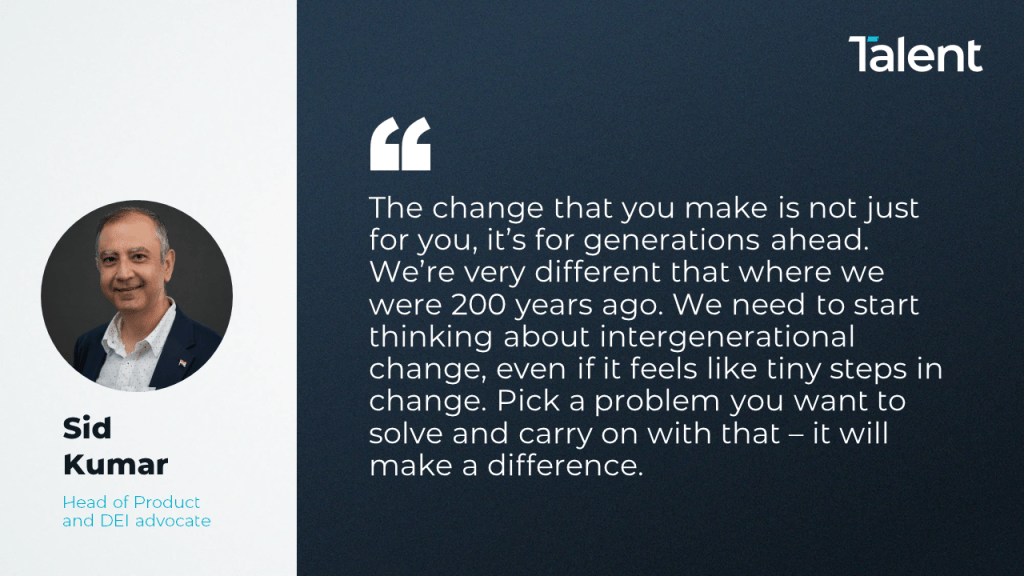
A few weeks ago, I was a panelist at a breakfast panel discussion hosted by Talent, a leading recruitment firm. The topic was “DEI in Danger: How to champion DEI initiatives during tough times“. I don’t believe companies need to spend a lot of money.
Firstly, a two-hour training on DEI can’t solve systemic issues. Yes, it is useful for some awareness, that’s it. No one remembers a thing or actually cares about a week later.
Secondly, people are clever. Any act of tokenism is noticed. Yes, it is fun to celebrate Diwali or Ramadan. If it’s only done to appear inclusive and diverse, people find out. Without an intent to include, it is tokenism.
What could you do on a budget? A lot. Here are some ideas to get started:
- Create the conversation – Use your internal social channels, like Yammer or Slack, to foster discussions. Approach these conversations with empathy and perspective.
- Check how you hire: Is the so-called merit-based hiring truly merit based? Get merit right so that there are no arguments about hiring for merit.
- Be aware of the biases: Ask the hiring managers to jot down their unconscious bias. Warning – this can be confronting!
The above are topics on their own, and worthy of a hearty discussion.
Start with equity. Be inclusive. Remember, diversity is the outcome. Not just diversity of genders, not just diversity of race, religion or skin colour, but diversity of thought. Perhaps DEI seemed like a catchy acronym, but it misses the point. Equity must come first, followed by inclusion, which leads to diversity. It should have been EID. After all, all animals are equal. Yes, some are more equal than others.
 Sid Kumar