
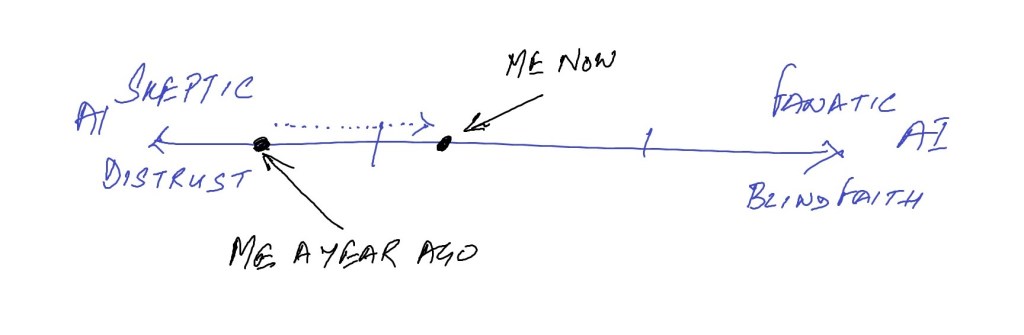
On the spectrum of Gen AI sceptic to Gen AI fanatic, I used to lean more on the sceptic side. Maybe quite near the edge. I remember having a coffee chat with a friend. I mentioned how I cringe at seeing LinkedIn feeds filled with Gen AI certifications. That was just over a year ago. I have now moved to somewhere in the middle of the spectrum. In fact, now I am a firm believer that if you don’t embrace Gen AI for your work — your career might actually stall.
No matter what your profession is, as a knowledge worker, AI has a use case. However, there is a method to this madness. There are new skills to learn as well. Skills that we seldom talk or care about. As any other tool in your professional toolkit, the result will depend upon the skills you learn to use and master the tool.
AI’s impact on different industries: There is a lot of hype out there such as doctors, lawyers won’t be needed. Rubbish. I see it integrating into various roles rather than replacing. The deciding factor will competence. We need to understand the difference between performance and competence. Gen AI can give a fairly logical answer, but the competence of the answer can be questionable. It is good at saying what an answer should look like and not what the answer should be.
The most interesting (and somewhat ironical) integration is in the world of software programming. For decades programmers have been writing code for AI models. Tables have turned — AI is now writing code for programmers. The challenge is that its data set is limited to the problems that have been solved. Do not expect it to solve unsolved problems, yet.
Gen AI has the potential to touch most type of roles in almost every industry. Unless it is highly manual, culturally sensitive, or personal. Does it mean that it will replace humans? No. It will surely change how we work.
How to get started with AI at work: Career progression doesn’t always mean a new job or workplace. It also means how could you do your job better in your current role. If you haven’t started yet, I can tell you how you can start based on my experience.
- Understand the basics of AI if you haven’t. There are many free and paid courses now. Many AI providers want adoption, so they offer free courses. It will get you the basic understanding. Understand its strengths and limitations. Understand its shortcomings.
- Identify your time-consuming tasks. Start simple, then move to complex.
- Research some tools that are specific to the task or sometimes generic tools could also work. They also integrate with your work.
- Experiment and monitor. You will not get it right the first time. There will be a hype cycle. I was wowed initially. Then it was like I am never going to use this. Now I have found a balance in my current role using AI.
- A word of caution: talk to your IT teams before you start using AI in your workplace. Not every company has a policy or guide. The free versions use the data to train their AI models. You might be sharing company sensitive information.
Key skills for the AI era: I see AI as a general-purpose technology. It has the power to transform the world we live in, similar to what electricity and Internet did. They are now part of our lives, and we don’t think much about them. Your career can boom if you can leverage AI, it can be a doom if you become the leverage. You can use some of these approaches that can be useful.
- Become a better reviewer – whether it is software code or a document, you cannot rely upon what the AI tool spits out. Create (not find) the balance between distrusting and blind faith.
- Join the dots – connect various tools together. Output of one tool (extraction) could be an input to the other (analysis).
- Shift the focus – create space for more upstream tasks that are more intellect stimulating.
I believe the skills that will be essential are the ones that will help us understand and integrate AI more.
- Soft skills: Not sure why they are called soft, these are really hard. Critical thinking. Problem solving. Conversational and communication skills. More on these in a later post.
- Technical skills: A useful skill will be understanding and analysing data – all forms of data. Qualitative and quantitative.
- Non-technical skills: AI can create a lot of ethical and legal challenges, including bias and privacy. I sometimes tell people not to confuse morality with legality. Logic and other philosophy concepts will set apart the best and the average.
A few weeks ago, I was a panelist at a discussion on the same topic. You can further explore some of the ideas and thoughts in the recording below.
If you don’t want your career to stall but accelerate it. Embrace AI. Experiment with it. Play with it. Dance with it. Use multiple tools. If you can, pay for it to get the most use of it. The key to remember is not to completely outsource the task to AI. You want to use it as your partner, a helper.
Take one small step today if you haven’t started yet. Sign up for a Gen AI tool. Ask your friends and colleagues which ones they are using. Not all tools are equal. Experimenting with multiple tools will ensure you have one that works best for you and the need.
Here are my favourite ones:
- ChatGPT for most of analysis work, including recognising patterns from large data sets.
- Gemini for any integration with Google Workspace apps
- Perplexity for research as it cites sources and easier to detect AI hallucination if no relevant sources
- Pi for further experimenting and playing, as it claims to be the AI with EQ.
 Sid Kumar