

I don’t know about you. I see middle management as the glue. The glue between the executive layer and the workforce that “does the doing”.
Organisations moving to a flatter structure tend to entirely eliminate this layer. If not eliminate, significantly reduce it. I am also not a big fan of seven layers of hierarchy, when there are six to seven managers between the CEO and junior-most employee. The message often gets distorted as it passes through multiple managerial layers before reaching the employees
So, who are the middle managers? Let’s say the CEO is L1, and their leadership team comprising of CXOs are L2. Typically, middle managers will be the L3 or L4 employees, depending upon the organisation’s size. If they are the glue, what are they joining? The purpose of glue is to join two or more things, establish a strong bond, and maintain the bond. The glue can be used in two ways. To create something new or fix something that is broken.
Joining things together: They join the dots. From top level strategy to the actual work being done to achieve it. They create a bidirectional flow. Making information, knowledge and wisdom flow freely, both ways. They are the layer that deliver the message in a way that make sense to the other layer.
Establishing a strong bond: They create a strong connection with both layers by reinforcing organisation’s vision and values. They help connect people across the organization. They translate the work to be done to make the vision a reality.
Maintaining the bond: This is perhaps the most crucial and often invisible part of a middle manager’s role—until something goes wrong. It involves daily micro-interactions at all levels, reading subtle cues, and understanding unspoken concerns (without overthinking). Middle managers act as ‘checkers,’ ensuring the needs of both executives and employees are met, thereby maintaining organizational harmony.
Have you experienced the impact of a strong middle manager in your organization?
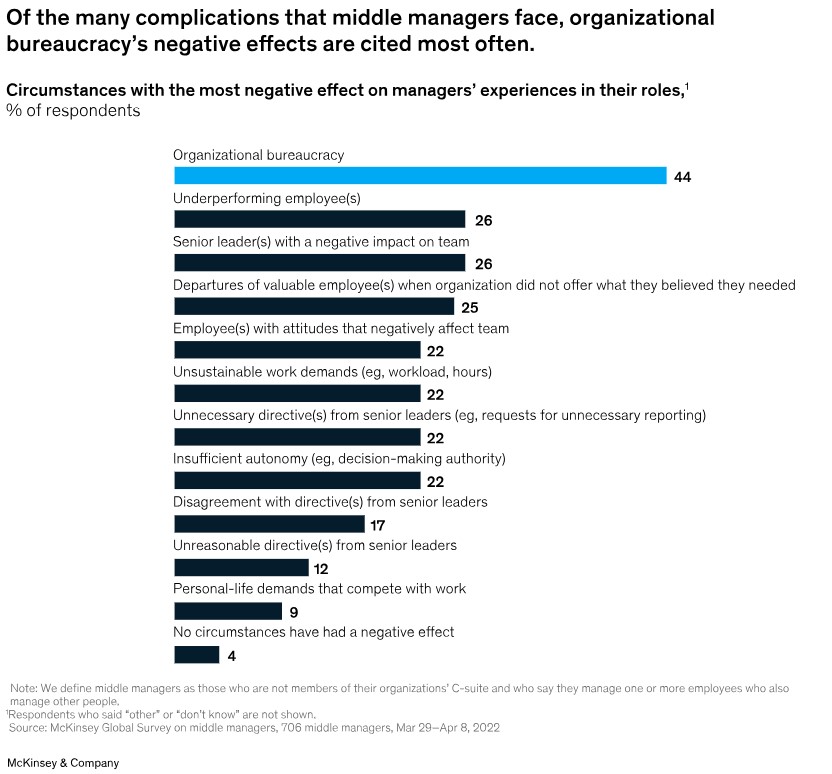
Recent studies, such as that from McKinsey below, have shown that middle managers are mostly hindered by organisational bureaucracy.
There is a very interesting HBR article, now tagged as an HBR Classic – The Middle Manager as Innovator by Rosabeth Moss Kanter. Kanter has an interesting point:
“Because middle managers have their fingers on the pulse of operations, they can conceive, suggest, and set in motion new ideas that top managers may not have thought of.”
Rosabeth Moss Kanter in HBR Article – The Middle Manager as Innovator.
The role of middle managers is sometimes underestimated, and often on the chopping block when the going gets tough. It is tough being one as well. Isn’t that also the paradox of leadership?
Apart from having the usual leadership skills, effective middle managers are those who are bilingual. They understand and speak the language of the executive. At the same time, they are fluent in the language of the teams.
Here is what Dilbert thought of middle management. :)🙂
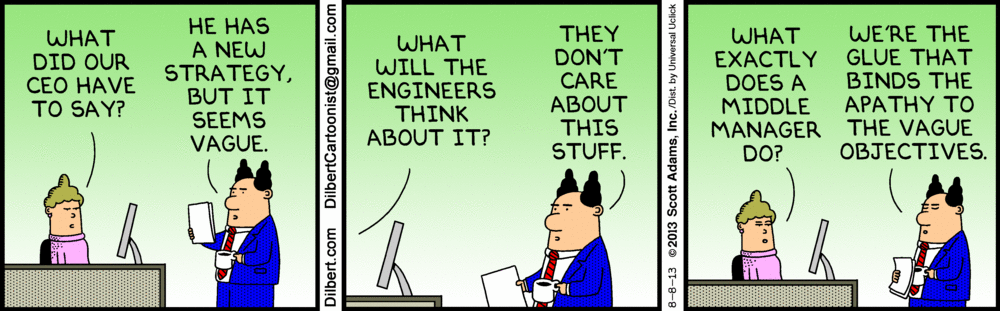
© Scott Adams, creator of the superb Dilbert comic strip.
 Sid Kumar